12 New Business Set Up Strategies
Starting a new business is exciting—but without a clear strategy, it can quickly become overwhelming. The key is to balance vision with practical execution. Here’s a structured, real-world approach to setting up a new business successfully:
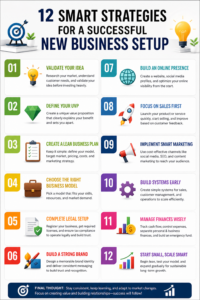
Start with a Clear Business Idea and Validation for Business Set Up
Every successful business begins with solving a real problem. Instead of jumping straight into launching, spend time validating your idea. Talk to potential customers, run small surveys, or even test your product/service on a small scale.
Ask yourself:
- Who is my target customer?
- What problem am I solving?
- Why would people choose me over others?
Validation reduces risk and ensures there’s actual demand before you invest heavily.
Define Your Unique Value Proposition (UVP)
Your UVP is what makes your business different and valuable. In a competitive market, “good” isn’t enough—you need to stand out.
A strong UVP should:
- Clearly explain your benefit
- Address customer pain points
- Be simple and memorable
For example, instead of saying “we sell organic food,” say “we deliver farm-fresh, chemical-free food within 24 hours.”
Create a Lean Business Plan
You don’t need a 50-page document, but you do need clarity. A lean business plan should include:
- Business model (how you make money)
- Target market
- Pricing strategy
- Cost structure
- Marketing approach
This acts as your roadmap and helps you stay focused during the early stages.
Choose the Right Business Model
Select a model that fits your resources and market:
- Product-based (e-commerce, retail)
- Service-based (consulting, agency)
- Subscription-based (monthly services/products)
- Marketplace model (connecting buyers and sellers)
In Bangladesh and similar markets, combining online + offline (hybrid model) often works best.
Legal Business Setup and Compliance
Register your business set up properly to avoid future issues. This may include:
- Trade license
- Tax registration (TIN/VAT)
- Business bank account
A proper legal structure builds trust and allows you to scale smoothly.
- Build a Strong Brand Identity
Branding is more than a logo—it’s how people perceive your business.
Focus on:
- Business name (simple and memorable)
- Logo and color scheme
- Consistent messaging
Your brand should communicate trust, professionalism, and clarity from day one.
- Develop an Online Presence Early
Even if you’re not fully digital, online visibility is crucial.
Start with:
- A simple website (WordPress or Wix)
- Google Business Profile
- Social media pages (Facebook, Instagram, LinkedIn)
Post regularly, share value, and engage with your audience. Early traction matters more than perfection.
- Focus on Sales First, Not Perfection
Many new businesses fail because they focus too much on “perfecting” the product instead of selling it.
Instead:
- Launch quickly with a minimum viable product (MVP)
- Start selling immediately
- Improve based on feedback
Revenue validates your business—not ideas.
- Smart Marketing Strategy
Use cost-effective marketing channels:
- Facebook Ads (high ROI in local markets)
- SEO for long-term growth
- Content marketing (blogs, videos)
- Referral programs
Don’t try everything at once. Focus on 1–2 channels and master them.
- Build Systems, Not Just Effort
From the beginning, create simple systems for:
- Sales tracking
- Customer management
- Inventory (if applicable)
Tools like CRM software or even organized spreadsheets can help you scale without chaos.
- Manage Finances Carefully
Cash flow is the lifeline of any new business.
Key tips:
- Keep personal and business finances separate
- Track every expense
- Maintain emergency funds (3–6 months if possible)
Avoid overspending on unnecessary things early on.
- Start Small, Scale Smart
You don’t need a big office or large team at the start. Begin lean, test your model, and expand gradually.
Scaling too fast without stability is one of the biggest reasons businesses fail.
Final Thought
Business set up is very crucial. A successful business isn’t built overnight—it’s built through consistent action, learning, and adaptation. Focus on solving real problems, generating revenue early, and building strong customer relationships. If you stay disciplined and flexible, your chances of success increase significantly.
Please feel free to knock me for any assistance: https://tamalkabir.top/